
Shaolin Five Animal Kung Fu / Wushu – Personality Types and Training System
These animal styles describe different ways people think, act and solve problems.
Exploring the Five Animals
Welcome

I am not saying that the way most people see the Shaolin Animal Styles is wrong. It is just that I see much more in the message when Shaolin chose those five animals. Why two great cats? Why then a bird and a reptile? As you possibly know, many Five Animal styles choose Monkey, Eagle, Mantis and others to make up their Five Animal Style. I just think that most have not thought it through.
For me, it is not animal noises, specific movements, fist shapes and odd sounds, but personalities.
There are many people in the world who will not hit someone to save their lives. If you watch streams where people get hit, it is clear. Some will not or cannot defend themselves. It is not in their nature. It would also be in the nature of most Shaolin monks not to harm any living creature. If they do, they are responsible for them, and this would also bring bad karma. Shaolin needed a style of martial art, Kung Fu / Wushu, that suited these people too.
I am predominantly a Tiger. I do not really have a problem defending myself. I will not hit first, but I will when attacked. Cranes are the ones who prefer to avoid, evade and wear down an attacker with grace, agility and skill. The Panther will outthink the attacker but still have the skill to manage a confrontation, though not head-on like the Tiger. The Snake is the surgeon. It will avoid a direct confrontation until in a corner, and then it will use its knowledge of vital and pressure points, knowing where the most vulnerable, less obvious spots are.
Simply put, we have force, mind, spirit and knowledge, and when you can combine those together, you become the Dragon.
Options
Now you have three options.
Try the animal-style questionnaire and discover which animal personality you are and which you wish to become. Or read on about the animal styles and find out more about the Shaolin Academy Five Animal Style.
Come down and see first-hand how this all works at our Cheltenham venue, 1218 Nepean Highway, on Tuesday, Wednesday and Thursday at 6pm, or Saturday at 10.30am. The initial three classes are free, and there are no minimum-term contracts or any such.
If you have any questions, about anything Shaolin, personalities, kung fu / Wushu, martial arts or training, call or email me.
Personality Styles
Background
I studied at the Australian Institute of Management for my MBA and was introduced to personality type indexes including MBTI, 16PF, MMPI, the Enneagram of Personality and DISC.
DISC is a behavioural personality model that measures how people tend to act and communicate, particularly in work environments and under pressure. I immediately saw a connection with the Shaolin Five Animal model, particularly when we examined not only what each model described, but also what each model left out.
The Jixiao Xinshu (New Book of Effective Discipline), written in the 16th century, provides a historical reference for martial practice. My interpretation of the Shaolin Five Animal principle extends beyond fighting techniques. It appeared to be something much deeper.
The Shaolin Five Animal system is one of the most recognised and enduring frameworks in Chinese martial arts. In the tradition I teach, its development is placed approximately five hundred years ago at the Shaolin Temple. The precise origin and historical use of each animal model need to be examined separately. In our teaching, it organises kung fu / Wushu training around five animal archetypes, each representing a distinct approach to movement, combat and ultimately to human character. The five animals are Tiger, Panther, Crane and Snake — each a complete martial arts style in its own right — and the Dragon, which represents the mastery of all four and is an ideal.
Not the First 5 Animal Style
For completeness, we need to acknowledge Hua Tuo (c. 140–208 CE), who created the earliest recorded Five Animal system of exercises based on the Tiger, Deer, Bear, Monkey, and Crane.
We know Hua Tuo existed from official historical records, but the exact Five Animal exercises we have today are probably later reconstructions. Hua Tuo was executed by Cao Cao, and his medical writings were destroyed or lost, but later generations reconstructed his exercises from tradition.
This is important because it shows that the concept of linking animal movement to health and training was long established in China, although possibly not widespread. Literacy among ordinary people was low unless they were part of the scholar class, monasteries, or government administration. As a result, martial arts history often survived through less reliable but culturally important means.
- Chinese opera and storytelling
- Secret society stories
- Family lineages
- Oral tradition
- Temple traditions
- Military manuals
- Local gazetteers
- Stories written much later
Entering the Shaolin Temple
Novices
The following account explains the novice’s progress as a teaching narrative. It illustrates how I understand the connection between physical training and character, rather than documenting a single curriculum used throughout Shaolin history. Historically, many monasteries in China provided food, shelter, education and training for young boys and men. Life in a monastery involved hard physical work, discipline, study and religious practice. At Shaolin, physical training and martial practice became part of daily life. Training therefore began with the body and discipline before a student could study philosophy or anything else. Over time, the training methods and teaching stories developed into systems such as the Five Animals, which were used not only to teach fighting but also behaviour, discipline and self-control.
Only later did the student begin to understand that the training was not only a physical workout for fitness, were they introduced to training styles. They learned that each way of moving, a way of thinking and a way of behaving. correlated to an animal metaphor. The student was not learning to become like an animal, but to provide segments to understand different aspects of human nature to develop their body, mind and character.
Shaolin Five Animal Personality Types
The Five Animal Model
The family is the easiest way I know to explain the Five Animal model. It brings together people who contribute in different ways, yet depend on each other. Someone takes responsibility and gets things moving. Someone looks after the people and keeps the peace. Someone remembers what happened last time. Someone asks why we are doing it that way and suggests something else. The animals give us a way to recognise those contributions.
- The father as Tiger: strength, protection, direction and responsibility.
- The children as Panther: curiosity, growth, questions, change and the future.
- The grandparents as Snake: knowledge, memory, wisdom and guidance.
- The mother as Crane: care, harmony, teaching and balance.
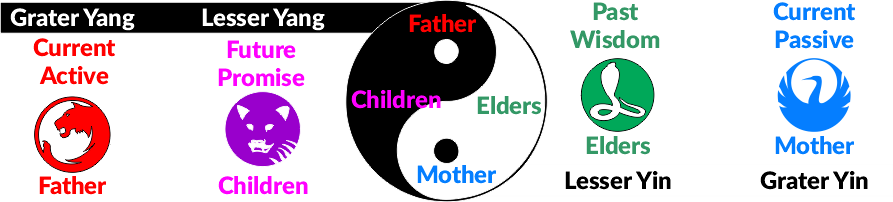
That is the traditional family picture I am using to explain the model. In an actual family, people may combine these functions or take on different ones as circumstances change. What interests me is how the contributions work together and how each person influences the others.
Who Leads, and Who Influences the Leader?
In this model, the Tiger leads. They take responsibility, set direction and act when something needs doing. The Crane, Snake and Panther each have an active part in how that leadership works.
The Crane notices who is struggling, who has been overlooked and where a decision may damage a relationship. A quiet word, a question or a patient conversation can cause the Tiger to reconsider. The Crane helps keep the family together while it deals with whatever needs doing.
The Snake brings memory and experience: “We tried that before. This is what happened.” Wisdom includes recognising when that experience applies, what may have changed, and which consequences deserve attention. It can save the Tiger from having to learn the same lesson again.
Grossmann and colleagues studied 247 adults in 2010. Older participants made greater use of reasoning that considered different perspectives, compromise and the limits of their knowledge. The study compared age groups; it does not mean age alone makes a person wise. It gives a useful comparison with the Snake contribution I describe here: bringing experience to a problem and considering more than the immediate answer. Read the study of age and social reasoning.
And children certainly influence their parents. Their needs, questions, resistance and discoveries change what parents do. A child asking “Why?” can make a parent examine a habit they have followed for years. That is the Panther contribution in this family picture: questioning, exploring and introducing possibilities.
There is research on this influence too. Lawson and colleagues tested a school programme in North Carolina and found that children could increase their parents’ concern about climate change. That particular study gives a practical example of children bringing something home that changes an adult’s thinking. I recognise the Panther contribution in that exchange. Read the child-to-parent learning study.
So the influence moves in both directions. The Tiger can provide clear leadership while listening, learning and adjusting. The other members help shape the direction and how the family gets there. Their influence also carries responsibility for the effect they have on each other.
Research offers an interesting comparison. In their 2014 study of Tsimane’ leadership in Bolivia, von Rueden and colleagues describe leaders who “lack coercive authority, operate via consensus-building”. Their findings show how leadership can depend on trust and cooperation. I see a connection with the Tiger taking responsibility while listening to the people around them. Read the leadership study.
When these contributions work together, the family can achieve more than its members could separately. In my teaching, Dragon brings these qualities together in the person you are working to become.
In this way the Shaolin monks did not try to force every student into one way of moving or thinking. Instead, the Five Animal system allowed training to be adapted to the individual. Shaolin Five Animal Kung Fu / Wushu was therefore not only about fighting, but about understanding people, understanding oneself and developing balance between strength, softness, growth and wisdom.
Understanding Who You Are
The reason the Shaolin Five Animal system has survived for so long may be found in the clever choice of animals. Two great cats — Tiger and Panther — are followed by a bird and a reptile. The choice of two great cats shows how similar these two character types are, while also revealing how different they become when the detail is understood. The addition of Crane and Snake is particularly interesting. These animals appear very different from the two great cats, yet there are many hidden similarities and connections between them. Most people do not see these subtle differences and similarities, and many teachers over time have tried to replace, add to, remove from or ignore this original idea.
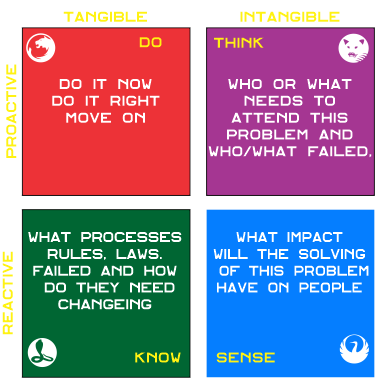
What made the Five Animal model more than a simple fighting system was the addition of the Dragon as the fifth symbol. The Dragon does not represent another fighting method but the ideal, the complete human being and the spiritual or metaphysical aspect of human development. The Five Animal model appears repeatedly in Chinese thinking — five senses, five elements, five directions and many other groupings of five. Because of this, the model is easy to remember and easy to teach, which may be one reason why it has survived for so long.
Black and White
Very little in this world is purely black or white. Most things exist somewhere between the two. Shaolin thinking was influenced by the principles of the Dao, which describe the world through Yin and Yang, two opposing yet complementary forces that exist in all things.
This idea can also be seen in the Animal model: greater Yang (Tiger), lesser Yang (Panther), lesser Yin (Crane) and greater Yin (Snake). While we will not go deeply into Daoist theory, these principles help to explain the animal characteristics and how they relate to human nature and behaviour.
Nature and Nurture
We will not enter deeply into the nature versus nurture debate. Our view is that genetics influence who you are, and upbringing influences how this is expressed. If your genetics predispose you to being tall and powerful, becoming a national ballet dancer will require extraordinary effort. Not impossible, but difficult. In the same way, your natural character and your upbringing both play an important role in shaping who you become.
Culture, Religion, Education and Environment
Culture, religion, education, ethnicity and quality of life belong to the nurture side of human development. They do not determine who you are, but they influence how who you are is expressed in the world. The same person, born into a different culture, time or environment, may live a very different life, yet still remain the same person at the core.
Normal and Challenging
Throughout life we develop habits shaped by our upbringing and experiences. In normal situations we behave according to these habits and social rules. However, when we face a truly challenging situation, one that creates real stress or danger, we may act very differently. In such moments, much of our civilised behaviour can fall away and something more instinctive appears. This is not always a truer view of who we are, but it is often a larger view of who we are.
Summary of Who You Are
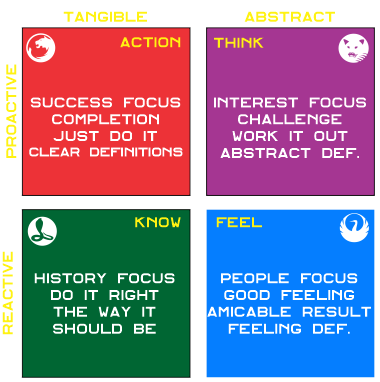
Who you are today depends partly on what you were given at birth — your health, size, intelligence and natural disposition — and partly on what happened to you afterwards. The opportunities you had, the environment you grew up in, and the people around you all influenced how your nature was expressed.
You may have had the heart of a tiger but been born into a strictly pacifist environment, and this may have masked your true nature. Conversely, you may be a very gentle person but have grown up in a harsh environment where you had to fight to survive. In that case, your true nature may have been hidden by necessity.
Parents also face two opposing tasks: allowing children to develop freely, and preventing them from harming themselves. Because of this, many people do not fully understand their own nature until much later in life. Parents are not perfect either — they were once children themselves, raised by parents who were also once children, and so on.
Movement as a Metaphor
The Easy Bits
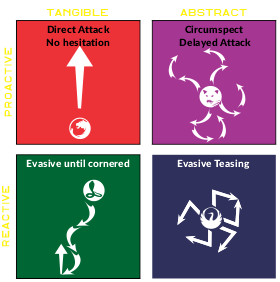
In Shaolin Five Animal Kung Fu / Wushu each animal has a preferred, often predominant, way of moving. The Tiger tends to go forward: direct, simple and immediate. The Snake prefers to withdraw, less direct but often just as decisive. The Panther will often evade first and then approach at a time and direction of its own choosing. The Crane evades first and only rarely attacks. Crane personalities generally dislike violence, dislike having to use it and dislike being confronted by it.
These movement preferences are not limited to physical movement but also appear in the way people think and solve problems. The Tiger thinker will attack the problem head on. The Snake thinker prefers to look for previous solutions and use knowledge and precision. The Panther thinker prefers to observe first and approach the issue once a full picture is understood. The Crane-style thinker prefers diplomatic, people-focused solutions and tries to resolve problems socially before resorting to conflict.
None of these approaches is better or worse. They are simply different ways of dealing with difficulty. The Tiger solves problems by action, the Snake by knowledge, the Panther by strategy, and the Crane by harmony and timing.
Sifu Chris S - Staking Panther Form - timing, observation and approach.
See It in Person
This is part of advanced training. Beginners start much simpler. Want to see how we actually train this? Come and try three free sessions at our Cheltenham Academy. You can watch, ask questions or join in. No booking required.
Preferred Solution Paradigm
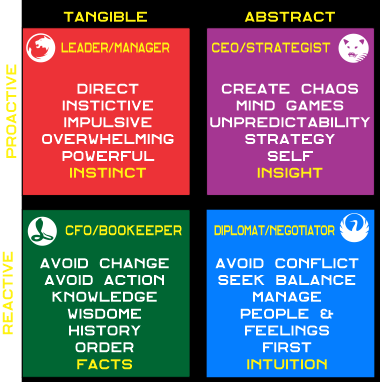
The Tiger personality, when confronted with a problem, will meet it head on. Directly and immediately. Little deliberation: deal with it and move on.
The Panther will first want to understand the issue, analyse it, get a feel for it and consider the consequences of any solution. Only then, when ready, will they take action, preferably using the most economical effort possible.
The Snake personality prefers to avoid problems where possible. If a problem cannot be avoided, they will often deal with it through careful research and observation: how has such a problem been solved before? They prefer knowledge and understanding, seeking a solution that prevents the problem from happening again.
The Crane personality will often initially step back from a problem and see if it resolves itself. If it does not, they may seek advice, support or cooperation from others. If the issue continues, they will begin taking small actions, not necessarily to confront the problem directly but to reduce its effect and gradually guide the situation to a better outcome.
Each of these methods has its place. Most people have a dominant problem solving style, a secondary style, and sometimes a third that appears under pressure or with experience.
Immediate Danger
The Tiger is well suited to emergencies requiring immediate action. The house is burning. A car is coming toward you. Someone is about to strike. In these situations the Tiger response is ideal: move, act, now. The Panther may overthink or hesitate, wanting first to understand the situation. Both Crane and Snake will often avoid danger effectively, but usually reactively rather than decisively. When immediate and direct action is required, the Tiger approach is often the most suitable.
Future Possible Danger
Imagine you cannot repay a debt to someone dangerous who has given you a week's notice. The Tiger's inclination may be to confront or counter-threaten. The Panther will wait, observe and try to understand the situation before acting. The Crane will seek help, advice or protection from others. The Snake will research and plan carefully, looking for a solution that has worked in similar situations before.
Something Needs Doing
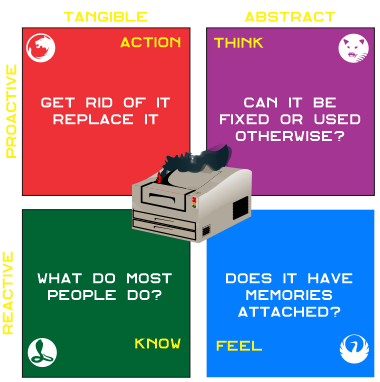
Consider the response of each style to a broken chair. The Tiger would try to fix it immediately. The Panther would question whether it really needs fixing at all. The Crane would think of who could fix it or how the problem could be solved cooperatively. The Snake would question the problem itself, perhaps finding a way to remove the need for the chair altogether.
Tiger and Snake both tend toward decisive solutions, though in opposite directions: the Tiger solves the problem directly, while the Snake solves the problem by removing its cause. Panther and Crane tend to delay action, though the Panther is more likely to return later and deal with the problem, while the Crane often prefers to resolve the situation through cooperation or support.
Yin and Yang Balanced
Tiger

When in balance the Tiger personality is a doer: direct, open, honourable and loyal to a fault. A good companion, quick to befriend, and with friends quick to forgive and forget. Often the life of a party, charismatic, entertaining and even witty when in a familiar environment, known territory, home ground and the like. When problems need confronting head on and time matters more than perfection, a Tiger is often the right person. As a task manager, perfect to get things done, but be very clear about the outcome you want.
A Tiger is a missile. Once loosed, they will achieve the outcome they understood.When in an unbalanced state the Tiger can be very intolerant of weakness and occasionally blunt to the point of rudeness. Quick to anger and to sulk at length. If back stabbed, wronged sevearly, or their trust is broken repeatedly, they can forgive but not forget. If they feel you lie to them, they will never trust your words again. Tigers can then also be aggressive and may take action if they feel threatened. They will act if they feel their pride, their family, or their tribe is in danger.
Caveat
Caveat: I am describing the sharp end of the stick here, the knife’s edge so to speak. In reality there are many shades of Tiger, and of all the other Animal Style behaviours, because most people are not just one style. Over time our styles usually broaden and soften, though not always. A person may act like different animals in different situations, but across a lifetime there is usually a pattern to who they became.
Plainly: Synchronic describes who you are in a situation, while Diachronic describes who you are across time.The Panther

When in balance the Panther is a thinker, a planner, and charming almost to distraction. Panthers move easily between different groups and situations, appearing friendly to everyone. Yet this is rarely accidental. They move through people and places to find the right tree, the right temple, the right corner of the world.
Panthers are complex thinkers and often solve difficult problems with very little information. When a problem is complicated and time is not critical, a Panther can achieve a great deal while appearing to do very little. They will usually walk their own path regardless of expectations, and not always toward the outcome others would prefer.
Where a Tiger will follow a well-trodden path if it is expedient, a Panther will avoid that path at all costs, but keep it in sight.
Panthers are self-guided missiles, able to meander for a long time and then strike unexpected targets.When in an extreme mental state Panthers are belligerent, stubborn, and non-responsive. They are present but withdrawn, participate but disruptively, never on time but also not absent. In the extreme they become chaos creators, but mask it well and often enjoy the issues they created, from a safe distance.
Like its animal group counterparts, each with a speciality, the Panther is the most difficult to define. Most Panther characters have one ability that is far superior to the people around them, though it is not immediately obvious.
This may be memory, perception, language, spatial awareness, reasoning, planning, problem solving, imagination, pattern recognition, timing, coordination, self-control, or the ability to change strategy quickly. In equal measure, one of these abilities is often very poor, almost absent.
Perhaps an analogy helps where words fall short.
Solving the Gordian Knot. Alexander the Great solved it by pulling out his sword and cutting it in half. That is classical Tiger. A Panther will find the solution, but keep it to themselves unless there is a substantial gain in it for them.
The Crane

A Crane personality is a carer, a listener, and usually a genuinely kind person. They are very good with people, listen carefully, and contribute thoughtfully. They are often need-driven, meaning whoever has the greatest need gets their attention. They prefer to gently guide people and situations rather than confront them directly, and are often the social butterfly of a group.
Crane personalities remember birthdays, anniversaries, and often care for others before themselves. In the workplace, club, or family they are the oil that keeps things running smoothly, filling in where needed, de-escalating situations, spotting the person alone and including them, and generally trying to keep harmony.
The Crane personality’s challenge is that this can cause them to lose themselves in the problems of their family or group, trying to help everyone until they have little energy left for themselves. They can drift toward martyrdom without realising it.
The extremes of the Crane are often less visible than those of the Tiger or Panther, because they are more internalised. A negative, stressed, overworked, under-appreciated Crane personality gossips, vents, and lays blame freely. You might find them in a café with a friend venting about partners, bosses, family, children, or the injustice of life.
If we extend the Gordian Knot analogy to the Crane, the Crane would not cut the knot and would not walk away from it. The Crane would slowly, patiently, over time tug, pull, loosen, and work at the knot until eventually it came undone.
The Snake

The Snake personality is comparatively simple to understand. It is about order, knowledge, and the experience of others. Continuing the Gordian Knot analogy, the Snake would study the knot first and then try to find how it was solved in the past. The Snake does not necessarily want to solve the puzzle personally, but prefers to find the person, method, or tool that is most suitable and then direct others on how to solve it.
Snakes can sometimes appear inflexible, preferring proven methods over new ideas. They often rely on facts, procedures, and experience rather than offering a personal opinion or making an outright decision. They are more comfortable saying “this is how it is done” than “this is what I think”.
The Snake character is a Gatekeeper: a person who prefers being in a central position and controlling access to something of value such as information, decision makers, clients, resources, or opportunities.The Snake character is the least likely to show large visible differences between balanced and unbalanced personality. When balanced they create order, structure, and continuity. When unbalanced they create bureaucracy, delays, and rules for the sake of rules.
Gray Areas
Shades of the Animal Personalities
We touched earlier on Diachronic personality, and on short-term situational behaviour, which is Synchronic personality.
From this we need to understand that situationally each character style can vary a great deal. When the house is burning down, not even the most ardent Snake character will try to read a book or manual about what to do.
Equally, if the Tiger personality has hit a brick wall, they will not, unless they are completely irrational, continue to push forward forever. In cases like this, each Animal character will usually choose an alternative, usually a less natural Animal Style. A Tiger dealing with a legal issue they cannot manage, for example, may ask an expert or their partner for help. A Panther is less likely to revert to another style, except to the Snake. The Panther values information when needed, unlike the Snake who values information, period.
In martial art terms, if a Tiger is confronted by an overwhelming force, they may turn to Snake methods and withdraw. If a Snake is pushed into an impossible corner, they may turn into an attacking Tiger. If a Panther is truly confounded by an issue and lacks information, they may temporarily become Crane and ask for help. If a Crane is in trouble, in a worst-case scenario it may turn inwards. In a physical situation, it may attach itself to a strong Tiger and rely on their aura of comfort and strength.
I believe that most people have a preferred success path. I, for example, am a strong Tiger. When my style does not work, I sulk for a while, then look for information first (Snake), then try to talk it over with someone (Crane), and then, only as a last resort, ask someone whom I believe is more intelligent than myself.
Ideal?
A workable group gives each contribution room to do its job. The Tiger provides direction and movement. The Panther considers alternatives and influences the circumstances around the problem. The Crane notices the effect on people and works through the communication and relationship problems. The Snake contributes relevant knowledge and experience.
Each also helps moderate the others. The Crane can ask the Tiger to slow down and listen. The Tiger can help the Crane make a decision that has been delayed too long. The Snake can point out a known consequence, while the Panther can question whether the old method still suits the problem.
Under strain, these contributions can become less helpful. The Tiger may push too hard. The Crane may exhaust themselves trying to keep the peace. The Snake may hold back until things are going wrong, then become severe and impose rules. The Panther may keep examining possibilities while others are waiting for a decision. Balance depends on how they respond to each other.
This is why I return to the family as an example. It has had to manage work, protection, care, learning and disagreement across generations. If you are building a team, a group or a community, consider whether these contributions are present and whether people can actually make use of them. A leader needs people who will speak, and those people need a leader who will hear them.
How to Manage
The Tiger
Tigers are natural leaders but can also be impatient and forceful. Give clear direction, guidance, or information and then let them run with it. Do not try to control every step. Instead, suggest clearly what needs to be achieved and appeal to their sense of responsibility and capability. Tigers respond well when they believe the task is important and that they are trusted to handle it.
The Panther
Panthers work best when they feel they have deduced what needs to be done themselves. Do not simply tell them what to do or what outcome you want. Instead, pose a problem and discuss possible approaches, guiding the conversation carefully. Panthers respond well when they believe they understand the situation and have chosen the path themselves.
The Crane
Cranes need to understand and feel the human side of a problem. They need to see the impact on people and the benefit of solving the issue if they are to work well. They respond well to support and encouragement, especially when they feel someone strong has their back. They may need occasional gentle refocusing if they become too absorbed in people or group issues. Cranes are often the grease and glue that holds groups together.
The Snake
Snakes work best when structure is clear and processes are defined. They prefer order and will impose their understanding of structure through control of information, procedures, and rules. Changing established processes or agreements can cause them to withdraw or resist through technicalities, rules, or procedure. Managing a Snake can be difficult and requires patience, clear reasoning, and respect for structure and process.
Internal
Drivers
What makes people give extra effort, over-achieve or do more than required? Often it is either fear or pride and honour. For Tigers and Snakes it is often the fear of losing position, control or having change imposed from outside. They have their place and anything threatening it is taken seriously.
Panthers and Cranes are less attached to position but far more sensitive to people and relationships. The Panther fears the inconvenience and disruption of forced change and new structures. The Crane fears the loss of social support, relationships and group belonging.
Tigers and Snakes tend to fear the tangible consequences of change. Panthers and Cranes fear intangible losses. A question like “what are you really losing?” is much harder for a Crane or Panther to answer than for a Tiger or Snake.
The Tiger would least like to lose their position of control. The Panther works best from a position of influence rather than authority. The Crane would struggle most with losing their social and professional network. The Snake would struggle with losing their accumulated knowledge, systems and operational detail when changing positions.
Older and Wiser
As people get older they either become wiser and better able to deal with a wider variety of situations, or unresolved experiences push them in the opposite direction. People who have experienced significant trauma are sometimes unable to cope with change and can become increasingly rigid in their style. Tigers can tend toward aggression. Panthers toward overthinking and withdrawal from reality. Cranes toward excessive caretaking and withdrawal. Snakes toward obsession with tangible or intangible certainties.
This is not to say that all extreme or unusual behaviour is always style based. Life experience is also a powerful influence. But significant trauma can sometimes push people toward an exaggerated version of their natural style. At the Shaolin Academy we observe this empirically rather than claim any clinical qualification to diagnose it.
Growing and Expanding
With experience, with success and failure, and with the opportunity to observe others and understand yourself, most people gradually broaden their approach. At some point you will notice that you use, in varying degrees, all four methods of operating. You will find you have:
Primary — your preferred and habitual response to life, problems, communication and most situations.
Fallback — your secondary method when your preferred approach did not achieve the result you wanted.
Third option — the approach used when both primary and fallback have failed. Usually not your strongest method, but better than repeating what is not working.
Last resort — the method you are most reluctant to use, almost regardless of circumstances. Under extreme pressure you may consider it, but it will never feel natural.
Reality
A Flawed Human
I will use myself as an example because I know myself reasonably well now. I am Sijo Robert Z. Let us look at what happens when I purchase a new piece of technology, for example a 4K video camera.
My preference is doing, so I go to the store and start asking questions, trying to find the camera with the most options, best quality and fewest problems. If two or three different people tell me similar things about a model and it feels right, I buy it. I might also check online for facts and prices. If all is well, I buy it. But what happens once I have it is altogether different.
Once unpacked I immediately try to use it. If I can successfully record a scene and play it back I continue exploring what else it can do. Much like a child with a new toy. This is the Tiger way: do and learn, discover and achieve. But what if I cannot get it to work?
My first thought is that there is something wrong with the product. If there are friends or students around I would ask them to try it. This is my fallback style — Crane: call a friend. If no one could figure it out, I would very reluctantly read the instructions. I would find the one crucial piece of information that was missing and go back to playing. If all this failed I would put it aside and give myself time to think. So: Tiger, Crane, Snake and then Panther.
Earlier I described looking for information before talking a problem over. With the camera, I may ask someone nearby first. That difference matters: the people present, the problem and what I have already tried can change my next response. The model helps me notice those choices.
Now that I am older and a little wiser, I use the Panther more often. The more I use it the better it works. I am still not good at puzzles, but I am good at waiting and creating the conditions for an insight to arrive.
My wife Dagmar (Crane) works differently. She unpacks just enough to get the instructions, reads them first, and only then tries the device. If problems arise she brings it to me or at work shows colleagues. Her pattern is Crane, Snake, Panther and then Tiger.
Why I Return to the Family
The family has helped people care for children, share work, pass on knowledge and deal with danger across generations. I see that long history as a strong argument for the value of complementary contributions. The animal model gives me a practical way to explain them: Tiger for direction and responsibility, Crane for care and harmony, Snake for knowledge and wisdom, and Panther for questions, discovery and the future.
My argument is that a family’s success depends on how these functions work together. The leader influences the family, and the family influences the leader. A person can take responsibility without having every answer, and another can change a decision without taking over leadership.
That is what I mean by balance between the animals. It gives us a way to look at our own family or team: who provides direction, who notices the people, who brings the knowledge, and who asks the question that changes how we see the problem?
Summary
The Five Animal personality model is the one I relate to best — better than MBTI, Big Five or VIA. It is possibly one of the oldest personality models still in active use and certainly one of the least known despite its longevity. It is not the only model using animal metaphors, but it is one of the most complete and one of the few deeply connected to a physical training system.
There are few things in life as important as getting to know yourself and the people around you, especially if you are going to make any significant commitments. Whatever model helps you do that is the right model for you.
In the simplest possible terms: the Tiger gets right to it, directly targeting the core and the centre line. The Panther circles the problem first, looks at it from different angles, and searches for an advantage. The Crane avoids the direct confrontation and looks for an indirect solution that does not require conflict. The Snake retreats into books, manuals, guides and history, and only comes forward again when it has enough information, or when it is forced to act.
Each method has its place and no method fits all.You can explore each animal in more detail here: Explore Tiger, Panther, Crane and Snake
How Do the Animals Appear in Your Own Choices?
You have read how the four methods work. Now consider the choices you make. The questionnaire explains your leading animal, the other methods in your result and the changes you would like to practise towards your Dragon state. Your next-highest score shows another preference; consider your own experience to recognise what you do when your first approach fails.
Five Animal Kung Fu / Wushu
In my experience, the physical techniques of Animal Kung Fu / Wushu are only the visible part of the system. They are like the tip of an iceberg. What most people see are the movements, the forms and the fighting methods. But over time I came to believe that the real system sits underneath.
Under the surface are ideas about behaviour, problem solving, teamwork, leadership, personality and understanding yourself and the people around you. The Tiger, Crane, Snake and Panther are not just ways of fighting. They are ways of approaching problems, work, conflict and life in general.
The animals are not just kung fu / Wushu styles, they are problem solving strategies.If you want to understand this better, you can look at each of the animals in more detail below.
The personality interpretations presented here are a modern way of explaining traditional animal strategies and are not meant as historical doctrine but as a teaching model to understand different approaches to problems and people.
Background Reading on Shaolin History and Human Behaviour
These references cover Shaolin history, understanding yourself and others, leadership, learning and social reasoning. They provide background for this discussion. They are not direct sources on Five Animal Kung Fu / Wushu or its personality model.
- Sun Tzu, The Art of War, chapter III, section 18. Lionel Giles translation, available through MIT’s Internet Classics Archive.
- Meir Shahar, The Shaolin Monastery: History, Religion, and the Chinese Martial Arts, University of Hawai?i Press, 2008. Book and publisher details. Further reading on Shaolin’s historical development.
- Christopher von Rueden, Michael Gurven, Hillard Kaplan and Jonathan Stieglitz, Leadership in an Egalitarian Society, Human Nature 25 (2014), 538–566. Read the full study. DOI: 10.1007/s12110-014-9213-4.
- Danielle F. Lawson, Kathryn T. Stevenson, M. Nils Peterson, Sarah J. Carrier, Renee L. Strnad and Erin Seekamp, Children can foster climate change concern among their parents, Nature Climate Change 9 (2019), 458–462. Study and publication details; full study PDF.
- Igor Grossmann, Jinkyung Na, Michael E. W. Varnum, Denise C. Park, Shinobu Kitayama and Richard E. Nisbett, Reasoning about social conflicts improves into old age, Proceedings of the National Academy of Sciences 107 (2010), 7246–7250. Read the full study. DOI: 10.1073/pnas.1001715107.
The animal personality interpretations and examples on this page are my teaching approach. The references provide historical reading and research on leadership, learning and social reasoning. The connections I draw between those studies and the animals are my interpretation. The studies did not test this animal model or validate the questionnaire as a psychological test.
Explore Each Animal Style
See the Five Animal Methods in Practice
We teach Shaolin Kung Fu / Wushu at Cheltenham Hall, 1218 Nepean Highway, Cheltenham VIC 3192. Come in, watch a class, ask questions or join in for three free sessions. No booking required.
Classes rarely exceed eight to ten people. Two fully qualified instructors are always present, usually including at least one master-level instructor.
Questions
If you have any questions about personality styles, martial arts in general, or kung fu / Wushu, you can email me anytime sijo@shaolin.net.au or call me 0458 742 654 9am-9pm.
🧭 The Compass
Let me guide you through a selected set of pages about Shaolin Kung Fu / Wushu training and our academy. Just click on the "🧭 Let me guide you ➔" button and follow the compass. Or explore freely. We have many pages on martial arts, weaponry, training, techniques and more.